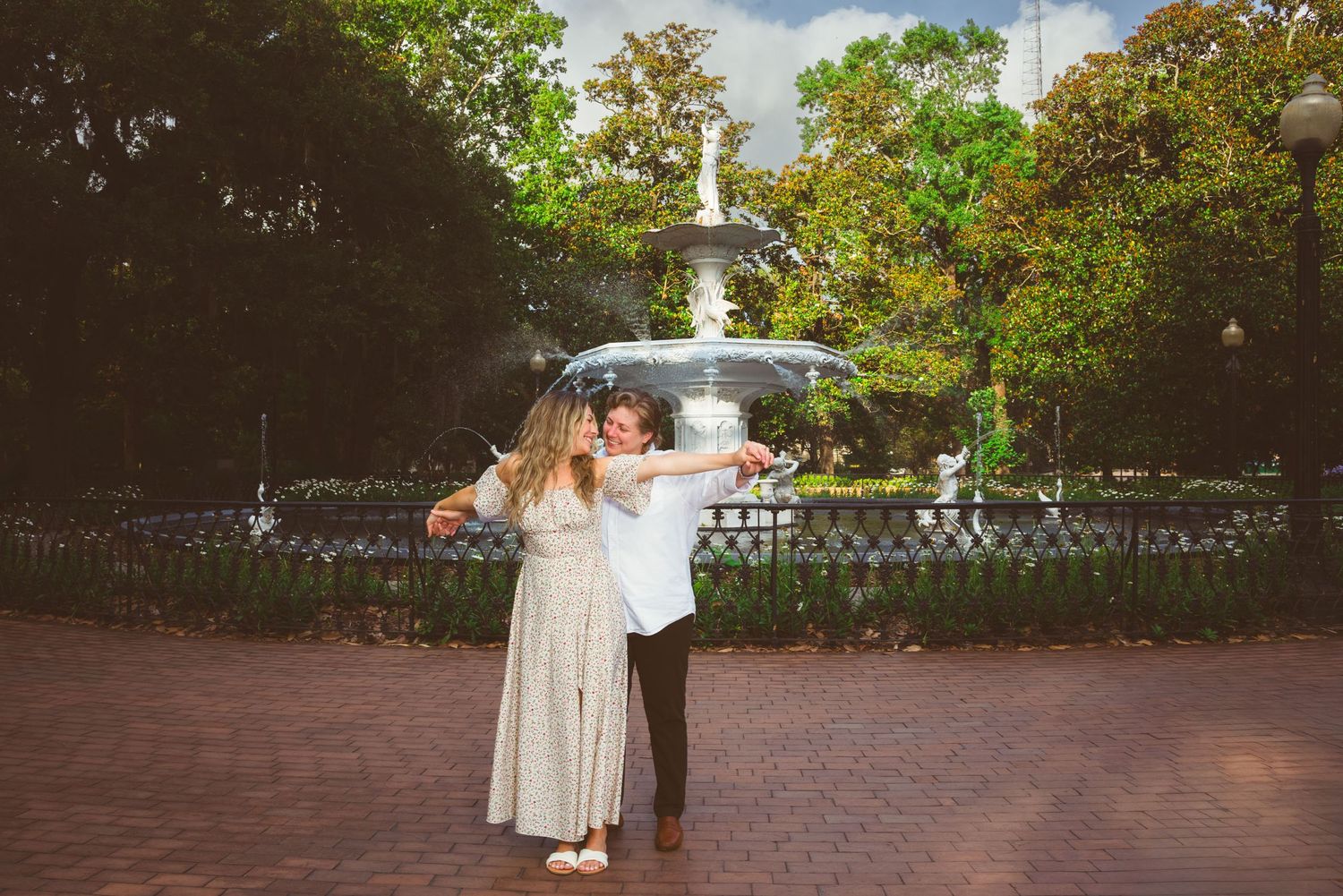
Forsyth Park contains one of Savannah’s most iconic features—the Forsyth Park Fountain. That’s one of the reasons I always start my tours with friends and family here. It’s part of what I like to call my “Savannah Starter Pack.” While the fountain is certainly one of the most recognizable landmarks in the city, there’s so much more beauty, history, and culture surrounding Forsyth Park. So let’s start at “the beginning” of my Savannah Starter Pack Tour.
The park is located at the southern end of the Historic District and marks the beginning of the Victorian District. At the time of its founding, the area north of the park had already been developed according to General James Oglethorpe’s (the founder of the colony of Georgia) original city plan. That’s why you won’t find any of Savannah’s 22 iconic squares south of Forsyth Park. At 30 acres, it’s the oldest and largest public park in Savannah.
In 1841, William B. Hodgson donated 10 acres of pine forest for public use—making it one of the first municipal parks in the United States. Hodgson, an American diplomat, was married to Margaret Telfair, sister of Mary Telfair (namesake of the Telfair Museum). Since the land sat outside the original city grid, it was undeveloped at the time. Hodgson even paid out of pocket to have the land fenced in to keep livestock out. When the park opened, it was named Hodgson Park in his honor.
Some sources claim the remaining 20 acres were donated in 1851 by former Georgia Governor John Forsyth, but this conflicts with his death in 1841. What we do know is that in 1851, the city reclaimed the land and the park was renamed Forsyth Park.
A professional landscape architect named Bischoff, originally from Bavaria, Germany, was hired to design the park. At that time, the entire area was enclosed by railings. Many of the pine trees were removed and replaced with sidewalks, ornamental plants, and decorative landscaping. Bischoff’s original design featured a central path aligned with Bull Street, bordered by asymmetrical, curving walkways with a circular focal point at the center. Over time, those curving paths were straightened into the concrete walkways you see today. The park’s fence was eventually removed in 1896.
The final 20 acres of the park were used by the Confederate Army as a parade ground beginning in 1860. Around 1909, two mock concrete forts were built on the grounds, designed by U.S. Army draftsman Jacquelin M. Braxton, and used for World War I training. Today, those former training buildings serve a new purpose: one is the Fragrance Garden, and the other houses the Collins Quarter restaurant.
The Fragrance Garden, located in what was once the west fort, was created in 1963 through the efforts of local garden clubs and private donors. The design was the final project of Georges Bignault, Savannah’s city landscape architect since the 1930s. The garden was specifically designed to be enjoyed by the visually impaired, with fragrant plants and flowers selected for their aromatic qualities, and bronze plaques in English, Latin, and Braille identifying the plants. The iron gates at the garden’s entrance were salvaged from Union Station before it was demolished that same year.
The east fort is now home to The Collins Quarter at Forsyth, a popular spot known for its Australian-style food and specialty coffee. I definitely recommend adding it to your Savannah itinerary. They also have a second location at Bull Street and Oglethorpe Avenue. Just south of the restaurant, you’ll find a bandstand that hosts outdoor concerts and community events throughout the year.
Three notable monuments can also be found in the park. At the northern end is the Forsyth Fountain—hands down the most photographed and recognizable Savannah landmark. Interestingly, the fountain isn’t unique to Savannah; it was purchased from Janes, Beebe and Company in 1858. Identical versions can be found in Poughkeepsie, New York, and Cuzco, Peru. Savannah’s version was originally painted with brown veining to resemble Siena marble. The figure at the top is a woman, with tritons and swans in the lower basin spraying water upward.
In the center of the park stands the Confederate Soldiers Memorial—the tallest statue in Savannah. Although it was dedicated in 1875, it took the Savannah Ladies Memorial Association several years (from 1868 to 1874) to raise the $10,000 needed to build it. Strict conditions were attached: no materials could come from the North, no Northern workers could be involved, and it couldn’t pass through a Northern state. As a result, the sandstone base was shipped by sea from Nova Scotia and crafted by Montreal sculptor Reid. The bronze Confederate soldier now standing atop the monument wasn’t the original design. The first statues, titled Judgment and Silence, were unpopular with the public and eventually replaced. The current soldier, sculpted by David Richards of New York, was installed in 1879, facing north—symbolically “guarding” against the North. Silence was relocated to Laurel Grove Cemetery, and Judgment was moved to Thomasville, Georgia.
Two bronze heads of Confederate generals—Major General Lafayette McLaws and Colonel Francis S. Bartow—sit at the base of the monument. These sculptures originally stood in Chippewa Square for eight years before being relocated in 1910 to make way for the Oglethorpe Monument.
Two additional military memorials can be found in Forsyth Park. At the north end near Gaston Street is a marble slab with a plaque honoring local Marines who died in World War II, Korea, and Vietnam. At the south end, near Park Avenue, stands The Hiker, a bronze statue of a soldier commemorating the 50 Savannah men who fought in the Spanish-American War. Installed in 1936, the statue was sculpted by Alice Ruggles Kitson. And here’s a little local trivia: if you notice damage at the base of the statue, that’s from a recent collision with a drunk driver. It took a few weeks to reinstall.
Forsyth Park has always felt like the heart of Savannah to me—so much history, beauty, and charm all in one place. From the fountain to the hidden corners, it’s easy to see why I love starting my south route tour here. In the next post, we’ll take a walk around and talk about the beautiful buildings that surround it. There’s so much more history and beauty surrounding the park!
Citations
Williams, R. B., Gobel, D., Haughey, P., Rossell, D., & Schuler, K. (2016). Buildings of Savannah. UVA Press.
Hill, R. J. II. (2025. Savannah squares: A keepsake tour of gardens, architecture, and monuments. Schiffer Books.
Cooper, P., & Eldridge, T. (2016). Savannah: Then and now. HarperCollins.
Jordan, M., & McCay, M. (2015). Savannah square by square (Photographs by L. Wilkes, P. Hodgkins, & C. McCay). Historic Savannah Foundation/Spanish Moss Publishing.